


For the past two decades, software has dominated tech investment and innovation. It’s high-margin, scalable, and fast to market. It’s no surprise that trillions in capital have flowed into software-first businesses.
But the game is changing.
AI is fundamentally altering the economics of software development - and, increasingly, the logic behind building a company around a software product.
We’re now seeing the emergence AI-assisted software development and even what some are calling “vibe coding”: small teams, or even a single person, generating fully functional applications in days.
We’re still early, but it’s already clear that the time, cost, and effort required to develop software is collapsing, and like everything in AI, it will move quick.
Marc Andreessen once said, “Software is eating the world.” That held true for a long time.
But now, it feels like software is starting to eat itself.
And everything will change because of it.
Replication: The Death of Software Moats
Historically, building a great application meant owning a competitive moat. Proprietary code, thoughtful UX, engineering complexity, and years of iteration could keep competitors at bay.
But in a world where AI can generate 80% of a product in 20% of the time, those assumptions no longer hold:
- Replicating existing software could soon take weeks, not years.
- Small teams using AI agents can now match the output of larger, better-funded competitors.
- Increasingly, software will become a component of a business - not its sole product.
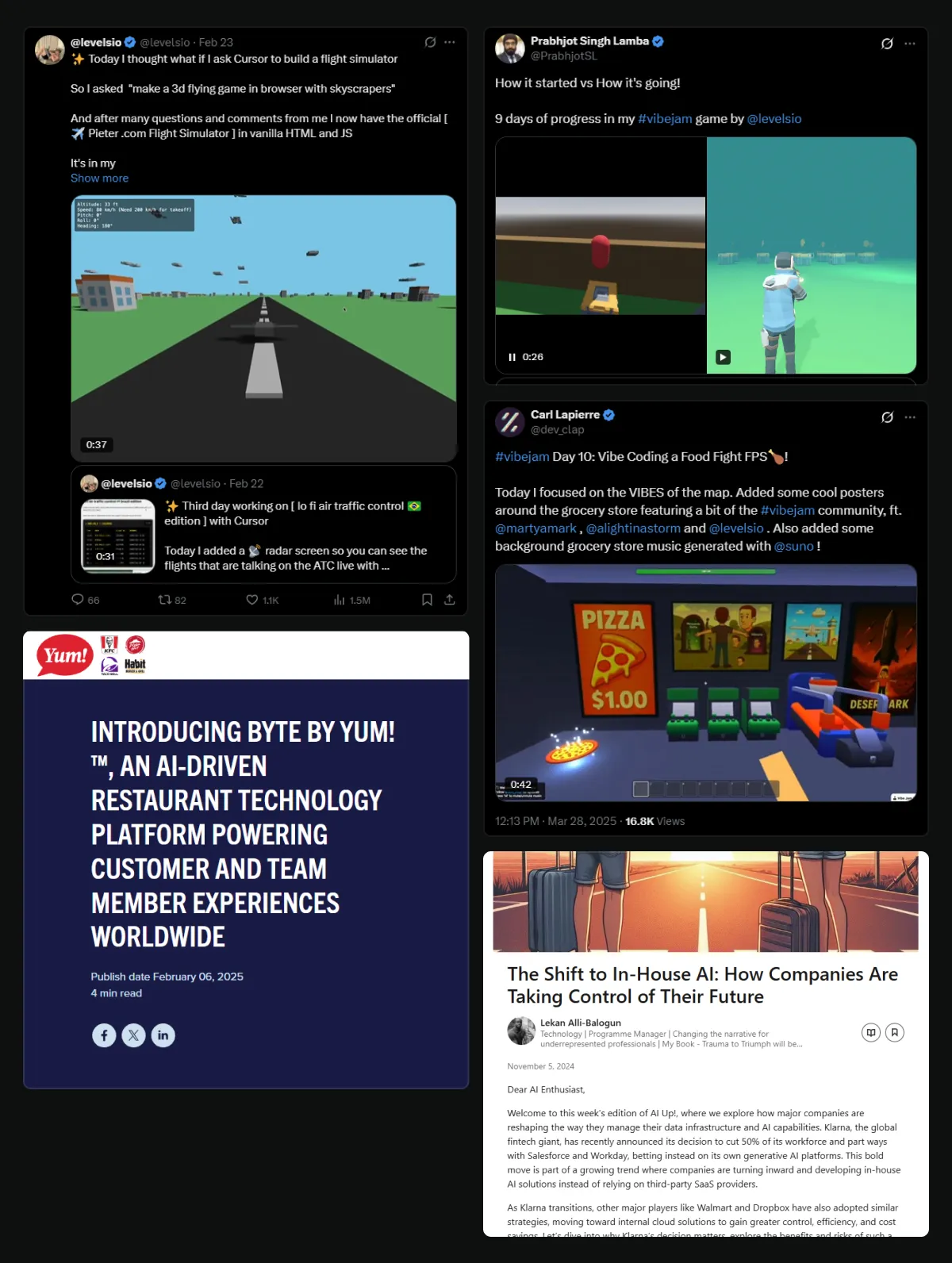
This isn’t theoretical. We’re already seeing examples of solo developers shipping AI-built games, and enterprises replacing off-the-shelf SaaS tools with internal AI-powered workflows, with many more examples out there we’re probably just not aware of yet.
What this signals is a genuine shift, meaning -
The value of software IP will decline over time
- SaaS companies will face a new kind of “replication risk”
- Product stickiness will hinge more on distribution, relationships and UX than on code
- Enterprises will start asking - is this software license more expensive than just building it in-house with AI tools?
This puts enormous pressure on many software-first businesses - especially those valued primarily on their technical stack.
However as always, change breeds opportunity.
The Infrastructure Bottleneck
I believe one of the biggest opportunities in the next decade will be running a non-replicable business servicing the huge increase in compute demand from this change.
Because no matter how fast or cheap it becomes to build software, it still needs somewhere to run.
Every AI-generated application will always need compute, storage, and networking. And as the cost of development falls, the volume of new applications will only rise.
That creates a new kind of constraint - digital infrastructure.
And unlike software, infrastructure can’t be spun up in a weekend, because:
- Deploying real infrastructure takes time. Licensing, regulatory approvals, data center builds, global connectivity - it’s a years-long process.
- It requires capital and deep expertise. You can’t prompt an AI to deliver low-latency networking in the Pacific or build a new, high-availability cloud zone.
- It lives in the physical world. Infrastructure means power, location, cables, people - things AI can’t virtualize away.
This is why we believe infrastructure will become one of the most durable, defensible parts of the tech stack over the next decade, seeing unprecedented demand.
Where the Value is Going
We’re entering a time where many of today’s dominant software companies - especially those built on single-product models - will face serious headwinds.
Their margins will compress, their products will be cloned and their users will be harder to retain.
At the same time, companies will start using AI tools to develop internal programs, tailored to their workflows. Entire software categories will likely be rethought, reimagined or just plain copied from the ground up.
But every one of these tools will still need fast, reliable infrastructure underneath them. And this is why I think OneQode is incredibly well positioned.
We’ve spent years building a company not for yesterday’s software market - but for the infrastructure-heavy, AI-native connected world that’s emerging.
And the timing feels right:
-
As AI accelerates software development, performance demands are rising. -> We’ve built a cloud platform that unapologetically prioritizes performance.
-
As businesses build their own tools and software, they’ll need infrastructure that can adapt with them. -> We’re built to offer true custom private cloud deployments, end to end.
-
As AI reduces the barrier to entry for software development and funding, more products than ever will come from global markets -> We have some of the deepest infrastructure footprints and unique, latency-neutral locations
-
As regulatory focus shifts, sovereignty of AI data becomes a big focus for many. -> We’re already deploying sovereign solutions for government and enterprise customers across the Pacific, and have a Guam as a unique backbone location for US companies operating in Asia
In short, as software continues to become more commoditized, the foundation it runs on will become even more valuable.
And as the old gold rush adage goes: when everyone is digging, you want to be selling the shovels.